Examples Of Mission Oriented Serial Killers
Stories and Essays/ Essays The Murdering Mind: A Closer Look at Serial Killers, from Jack the Ripper to Ted Bundy4/23/1991 IntroductionWhen a serial murderer is caught, the first question Society asks is the question why. 'Why did he do it?' In order to answer this question of why, one must ask himself 'Why ask why?'
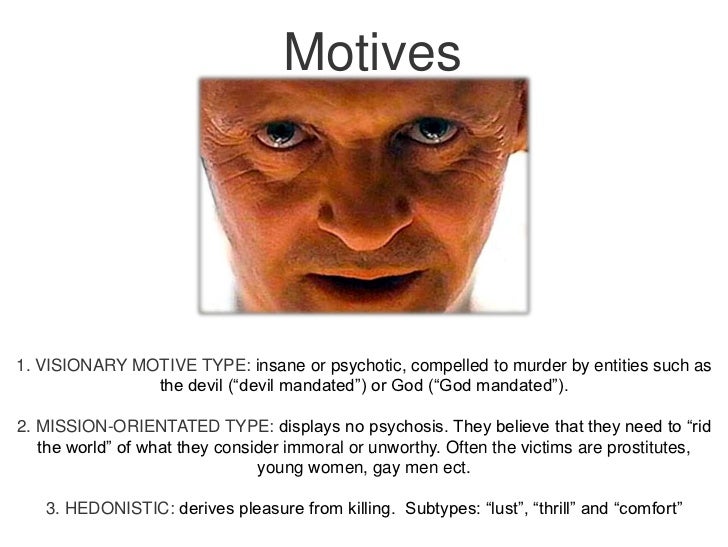
As Stanton E. Samenow in his book Inside the Criminal Mind states, 'We ask why to make sense out of a vicious, illegal, unprovoked act, hoping to learn something that will help us prevent similar crimes in the future' ( 5). In order to completely understand the reasons for serial killings, one must examine the motivations of such serial killers and discover the common factors that serial killers have. Also, the serial murderer's family background must be looked into, so that one can see whether or not this background motivates a human being not only to slay once, but also to slay again and again. Types of Serial Killers, Reasons and MotivationsOne way to find out the why of serial killers is to look at the motivations given in Holmes and DeBurger's book, Serial Murder: Studies in Crime, Law and Justice. Holmes says that serial killers can be divided into four different categories, each divided by describing what motivates the killer. Visionary KillerThe first of this type is the 'Visionary Type'.
These serial murderers kill because of 'voices'. This type of murderer is out of touch with reality, and is judged as psychotic by psychiatrists. To the murderer, it is a 'power' that commands the killer that a person or category of persons must be destroyed ( 55).
One example, of this was Harvey Carignan who stated that he murdered people in response to 'an edict from God' (55). Another murderer, Peter Sutcliffe, the 'Yorkshire Ripper', was a long distance hauler working in London. He murdered twenty three women by, striking a mortal blow with his favorite weapon of choice, a ball-peen hammer. He claimed to hear voices telling him that killing prostitutes was his 'divine mission' from God. These voices started when he was nineteen years old.
Joseph P Franklin
While working as a gravedigger, this 'voice of God' spoke to him from an old cross in the cemetery, telling him of his 'mission' (' ' 24).Another person that fit the 'Visionary' type was Cleo Green. During the summer of 1984 Cleo Green, a 24 year old black male, murdered four people in Louisville, Kentucky. According to him, he murdered under orders of a demon; thus, he was called the 'Red Demon' killer. This demon put him under continual agony and torment. Relief only came when he killed women and let the demon enter the bodies of the women. He, also, started hearing this voice early in his twenties ( 74).
Mission orientated Serial Killers. Mission orientated serial killers are those who think they do society a favor by ridding it of certain people. Their victims can include gay or lesbian, drug dealers, prostitutes or people in different religions. Mission orientated serial killers are not frequently psychotic. However, mission-oriented serial killers have also been known to murder based on sexual orientation and occupation; homosexuals and prostitutes have been targeted by this type of killer. A hedonistic serial killer is the type you’d expect to see in a psychological thriller or horror movie. Mission-oriented serial killers, on the other hand, are not typically considered. Hitmen, for example, are sometimes considered comfort killers.
The strangest case is Herbert Mullin, who murdered thirteen people in Northern California, late in the year of 1972. Lunde, in his book Murder and Madness, describes how he received 'telepathic messages', of course, from God. 'God' told him that murders prevented earthquakes. Mullin then proclaimed himself a savior of these people, and started sacrificing people to his God. This case was especially strange since he had many statistics to back up this 'theory' by studying records of data of great earthquakes and comparing the statistics of birth and death rates ( 65).
(Then again, 'If you torture numbers, they'll confess to anything.' Mission-Oriented TypeThe 'Mission-Oriented Type' killer has a conscious goal of eliminating a particular group or category of people. Unlike the 'Visionary Killer' he sees no visions and hears no voices. Usually, this killer decides to go on a 'mission' to rid the world of a group of what he calls 'undesirable'. This group can be of any class. The victim only has to meet the killers definition of 'unworthy' to qualify as a target ( 57). Albert DeSalvo, a serial murder that killed from 1962 to 1964 under the name 'The Boston Strangler' hated women so much since he thought that they were out to get him.
Quoted in Gerold Frank's book The Boston Strangler, he told police later that in his victims' cases 'Attractiveness had nothing to do with it. They were women.' Charles Manson was also a type of mission- oriented killer, even though never actually killed. But the fact that he controlled other people and made them kill for him places him in this category. He planned on creating a race war between the blacks and the whites so the members of his 'Family' would rule the world, taking over amidst the confusion (Bugliosi 281).Joseph Paul Franklin, of the early 1980s, on a mission of what he thought was of 'justice', killed as many as twelve young black males.all of whom had white female companions ( 57).
The case of Beoria Simmons proves that a serial killer could form from the most unexpected source. Beoria Simmons, a twenty-nine-year-old social worker in 1984 in Louisville campaigned against the immorality of women casually dispensing sexual favors. To him, only radical action would remove them from the realm of decent people. He started 'cleansing' the city by killing a teenage girl he thought was a hooker, and killed a few more before he was apprehended ( 58).
Hedonistic Type: Comfort Oriented and Lust KillerThe third type of serial murderer is the 'Hedonistic Type'. This killer is oriented more towards pleasure or 'thrill seeking'.
He has no qualms about murdering others as a means of expanding enjoyment of life. There is a 'rush of excitement' or a feeling of total relaxation during, and after these killings. There are two types of pleasure killers found, the 'Comfort Oriented' murderer and the 'Lust Killer'.
In the situation of the 'Comfort Oriented' serial killers the act in itself does not produce pleasure, but mainly is a means to an end. The murders are to achieve a goal, getting the pleasures of life. The murderer wants the creature comforts of life.A very good example of this type is Joe Ball, a San Antonio tavern owner in the late 1930s who murdered around twenty of his waitresses and other employees so that they could bring happiness to his 'loves'.
His pet alligators he kept in back of the tavern ( 59). There also is George ('Buster') Howard Putt, who murdered five people in Memphis, Tennessee in 1969 after breaking in their homes for their money ( 180). Watson, in 1910 El Centro, California married and murdered fifteen lonely widows who had no social ties and no families, during the space of fifteen years. Why did he do it?
According to Watson, he 'did it for the money' ( 70).In the case of the 'Lust Killer', the murderer does receive physical pleasure because of the murders. This is the killer who kills for sexual pleasure. Jack the Ripper was one of the most famous lust killers.
He is the most famous murderer today mostly because he was the first real serial killer. Before Jack the Ripper, motives for murders were clear cut. Common motives like revenge, power, greed and jealousy were found. This was one of the first cases where none of these 'logical' reasons apply. Even though there were gruesome murders, they usually could be explained.
Psychologists interviewed by David Rumbelow for his book The Complete Jack the Ripper believe that he achieved sexual pleasure by mutilating his victims, taking out their body organs ( 15). Another example of the 'lust killer' is John Wayne Gacey. John Gacey, a Jaycee clown, molested and then murdered thirty three boys and young men in the late 1970s, and buried them under his house. He wasn't discovered until a policeman that had received an anonymous tip. About this certain smell coming from his house. ( 72).Under this subcategory, the category of 'Thrill Killer' fits.
They kill purely for pleasure of killing, and pleasure of eluding detection. One type of this is Christopher Wilder, multi-millionaire.
In 1984, Christopher Wilder killed eight females by rape, binding, strangulation, and stabbing. When asked why he acted so sadistically, he replied that it was a way for satisfying his craving for 'kicks' or 'thrills' ( 77).
The fact is that these 'Thrill Killers' contain the best known murderers: Ken Bianchi and Angelo Buono, two parts that formed 'The Hillside Strangler'; Eugene Stano, a killer active in Florida that murdered 32 victims; Henry Lee Lucas, a murderer that roamed the United States with Otis Elwood Toole his somewhat- lover; Walter Ng, slayer of 25 people in South California; and of course the unsolved Zodiac murders of the late 1960s and early 1970s ( 77). Power/ Control-Oriented KillerThe last of these categories is the 'Power/ Control-Oriented' type.
This type of killer gets satisfaction from the process of having complete life or death control over the victim. For many of these killers, the 'fundamental source of pleasure is not sexual, it is the killers ability to control and exert power over his helpless victim' ( 59). Ted Bundy fits into this category. Some of the best knowledge came firsthand from Theodore ('Ted') Bundy when he consented to be interviewed by various reporters: 'Ted insisted that violence was never an end in itself, sex was almost perfunctory.
Gratification lay not in assault but in the possession of the victim.' Michaund, biographer of Ted Bundy had this quote from an excerpt of his book The Only Living Witness printed out in Esquire's 'When One Murders: Ted Bundy Talks About The Unthinkable' ( 61). Another killer of this type is Randal Brent Woodfield, the 'I-5' killer. Randal murdered from 1980 to 1981 and left bodies on Interstate Five in Oregon and Washington. He wanted to prove he was still 'good' even though he was cut from the Green Bay Packers, and in his eyes he went from 'hero' to 'reject' status ( 80). Common Factors of Serial KillersRonald M. Holmes and James DeBurger told of a study done listing all the common factors serial killers have (67).
This study was done in 1964 by W. McCord and J. McCord, called 'The Psychopath: An Essay on the Criminal Mind' published at Princeton.
They found that:A) The serial killer is asocial. No guilt is found breaking social norms of conduct ( 67). Otis Elwood Toole and Henry Lee Lucas, murderers that are prime examples. Toole was quoted as saying 'I killed people I didn't think was worth living anyhow.' He thought of killing 'like smoking a cigarette, another bad habit.' Lucas, murderer of Adam Walsh, a boy that was kidnapped from Hollywood, Florida said 'Once I've done a crime, I just forget it (' 47).B) He is driven by uncontrolled desires. He craves pleasure, excitement, thrills, and maybe even attention ( 67).
David Berkowitz, 'The Son of Sam', confessed to Dr. Abrahamsem, his psychiatrist, he loved the attention so much, that if he was ever let out, he probably would start killing again (186).C) He is highly impulsive, ignoring duties, responsibilities and restrictions ( 67).D) He is aggressive, reacting to frustration with fury and rage. One way of overcoming frustration is hurting something or someone ( 67).E) He feels little, if any guilt, committing any act without guilt or remorse ( 67).F) He has a warped capacity for love, tending to be cool and passionless, treating people as objects and means for his own desires and goals. 'The serial killer kills human beings casually as they kill animals that are pests' ( 67)G) Strangely enough these signs also point to another common factor. They usually come from abusive families ( 67). Family Background of the Typical Serial KillerFBI Criminologist, Robert Ressler, when interviewed about the Gainesville Campus Ripper of 1990, stated that there are definite links between serial killers and their family background.
'Most reflect a maladjusted childhood, usually the result of a broken family. News and World Report 32). But how does this 'broken family' hurt the child and cause him to lack the certain 'moral' qualities all human beings should have? To understand this, one has to delve into the killers past.Dr. Joel Norris and Brad Darrach came up with some important factors in outlining the life of a serial killer and factors why he may have started.
('An American Tragedy' 61). Usually, these problems started from birth. The pregnancies were disturbing, or the birth was traumatic, and the child 'sustained high emotional damage because they were unloved and rejected when they came into the world.' This rejection feeling continues through the person's teen-age years (58). Ken Bianchi is a good example of this step.
Ted Schwartz, in his book A Murderer's Mind: The Hillside Strangler, says that he was born of teenage mother who did not want him, and was shuttled back and forth for three months, achieving no stability until his first year of life ( 42). Henry Lee Lucas, born the son of a prostitute, felt unwanted and unloved all his life. David Berkowitz, who was also adopted, was also shuffled around, since his natural mother did not want him, and he suffered with this rejection for all of his life ( 32). Edmund Kemper III, a sexual sadist that was known to cut off the breasts of his female victims, was hurt greatly by his father and mother's separation, and he was constantly abused by his mother who wanted to 'make a man' out of him, using punishment and ridicule ( 54).Next, the abused child becomes very withdrawn, or violently destructive. Most torture animals to take out their anger (Norris 60). Edmund Kemper, loved to torture and kill cats outlet this violence. He started this when he was twelve.
In Kemper's case, cats were not enough, since he killed both his grandparents when he was fifteen, avenging his mother's and father's rejection ( 55). From the time they are born, these children are raped, beaten, kicked, thrown downstairs, and tortured ( 61). Elliot Leyton, author of Hunting Humans: The Rise of the Modern Multiple Murder, writes that, since the child comes from this troubled background, the child is 'desensitized' to violence ('Q & A' Macleans 6). In George ('Buster') Putt's home, Buster's mother accepted without complaint the father's violence. When Buster was not yet three months old, the father was arrested for beating Buster with a leather strap ( 120). Albert DeSalvo was beaten every night by his drunk father, and at the age of seven, witnessed his mother having all of her fingers slowly broken and her teeth knocked out by the father ( 201).Afraid to express anger against the abusive parent, the child becomes the 'little automatons' the parents want. The rage the child feels grows and festers, until outlets, like killing dogs, dissecting cats, are used until, as in Kemper's case, killing animals are not enough.
As a child, physical symptoms may appear, like headaches, hallucinations (leading to the Visionary Killer Holmes talks about), blackouts and seizures. These children are so numbed by the abuse and react less to fear, pain, or pleasure ( 63). In the killer's twenties, all of the killers rage, anger and hate become so great that he starts killing humans. The Killer Reaches AdulthoodInside, the child, now a man, loses the ability to feel, because the feelings of hurt and helplessness is too great ( 63). Ted Bundy, in recorded tapes by Michaund, admits this much.
Bundy, once a law student, familiar with psychology, claims that this deduction is correct. Bundy also said that the psychopathic urge that controls the killings was created in the abusive childhood of the killer. It usually progresses in stages, from soft core pornography, to crude fantasies, leading to rape and murder. When he was saying these things, he was not only talking about himself, but also about Otis Elwood Toole who shared an adjacent cell with him ( 81). These stages were evident in the Ted Bundy, Buster Putt, Albert DeSalvo, Otis Elwood Toole, Ken Bianchi, David Berkowitz, Henry Lucas, and Christopher Wilder.Dr.
Joel Norris pointed out that the killer murders because he feels that he must exert some power and control to have a feeling of self- worth. Serial killers go through this process while stalking his prey. The victim is a stranger to the killer. The killer first woos the intended victim, after stalking them. The killer then gains the victim's trust. Finally, the killer betrays the victim, just as a child the killer feels that he was betrayed by his parents.
The victim is actually a 'parent substitute', so the now grown child can 'get back' at the parent ( 84). After all of this tension is released, the murderer experiences a feeling of peace, known as the 'murder high'.
The murderer has satisfied his need for violence. In 'lust killers' this 'high' results in a powerful orgasm (84). This brings us to another question: if the killer is satisfied, why does the killer kill again and again? It is because this 'high' does not last since it is actually false. The killer then becomes depressed, because the killer 'has killed, symbolically, himself. Himself as a weak and helpless child with the child betrayed' ( 80). The killer then resumes his normal life.
Until the urge grows again too great, and the aggression needs to be released and he goes hunting for a new victim. This cycle continues until the killer is sick of his own sickness, where he contrives to be caught. Or he kills himself ( 84).
The Difficulty in Capturing Serial KillersThe main reason that it is so hard to capture these killers is thefact that they do not look like 'sickos', or 'crazy'. They appear just like anyone else. Leyton says 'Multiple murderers are not deranged idiots. They know what they are doing, which is to appease a grudge' ( 7). Park Elliot Dietz, a psychologist interviewed by Science Digest makes the terrifying statement, 'They appear chillingly normal.
If one were your neighbor, the only thing you'd notice would be that he didn't associate much with his neighbors' (47). To most folks Henry Lucas 'just seemed like an ordinary person.real polite and real nice' (' 22) Peter Sutcliffe was 'a very sensitive man.soft spoken, revered and devoted by his wife' (' 39). Both Herbert Mullin and Albert De Salvo were described as 'good boys' by people that remembered them. Ted Bundy was described as 'suave, dapper.the kind of guy you'd want your daughter to bring home' (' 38). The main reason these people can get away with murder is that they are not what society pictures them to be. The only way to stop these murderers is for society to recognize them for what they truly are. Until we find a way to recognise them, people like Ted Bundy, Kemper, Mullin and all the rest, are getting away with, literally, murder.
ConclusionEven though a bad homelife, abusive parents or poverty may be factors in common with serial killers, people must remember that they are not causes. Samenow points out that:'Criminals come from all kinds of familiesand neighborhoods.
Most poor people are law abiding, and most kids frombroken homes are not delinquents. Children may bear the scars of neglectand deprivation for life, but they do not become murderers. The environment does have an effect, but people perceive and react to similar conditions of life very differently. (They) are not hapless victims of oppressive social conditions. No factor or set of factors- sociological, psychological, or biological-is sufficient to explain why a person becomes a murder' ( 54).Professor Ann Wolbert Burgess backs this up by observing 'The killer is not viewed as a helpless pawn of his experience, but as being fully responsible for his actions' (' 20).
If the family background of the serial killer is a factor, yet, it is not a cause, then only one question remains.' What causes serial killers to form?' There is only one answer, as unsatisfactory as it may be.Nobody knows exactly why serial killers kill. And that is the scariest weapon serial killers use. Nobody knows how they form.and until we do, all of society is victim to that menace. Notes:These four types of serial killers were developed by analyzing 110 known serial murderers through court transcripts, interview data, case studies, clinical reports, and biographical accounts.
The intent Holmes and DeBurgerhad was to develop categories of dominant or central motives that could account for the repetitive patterns of homicide. In independent studies by others, it was found that slightly over 96% of the independent studies showed agreement between the categories ( 60).
At the trial, Herbert Mullin tried to explain why he murdered:I, Herbert Mullin, born April 18, 1947, was chosen as the designated leader of my generation by Professor Dr. Albert Einsteinon April 18, 1955.His hope probably was that the April 18thpeople would use his designation and its resulting power andsocial influence to guide, protect, or perfect the resources ofour planet and universe.One man consenting to be murderedprotects the millions of other human beings living in the cata-clysmic earthquake/ tidal area. For this reason, the designatedhero/leader and associates have the responsibilities of gettingenough people to commit suicide and/or consent to being murderedevery day ( 76-77).
The author pointed out that the mere presence of sociopathic tendencies does not in itself explain the 'why' of serial killings and that a more in depth study should be done ( 60). One factor that will not be covered in the main body of the paper is the question 'Does violence on T.V. Cause murders?' Because the question is not really relevant in this paper to the thesis. Yet, there will be a few 'experts' that say that T.V. Is evil and these 'experts' will go on for more than ten pages without giving evidence and proof backing up their speech and merely arguing with words.
The only 'authority' that seemed that he was speaking with authority was Hartnagel when he wrote 'It is possible that T.V. Violence influences behavior in an indirect fashion, through its impact on learned values. Television may make viewers so accustomed to violence that they define it as normal' (348).
Yet, Samenow points out that if we accept that external events, like media or movies or comic books, control the murderer, we are saying that the murderer is merely a victim of his outside surroundings. 'A person already thinking about crimes may pick up ideas from the media, or become certain about the feasibility of a certain crime. But a responsible person will not be turned into a criminal by what he watches or reads' (15). Bibliography.
Confessions of Son of Sam. New York: Columbia University, 1985.' Time May 22, 1978. Volume 27, p 22.' November 14, 1983. Volume 122, p 21.and. 'An American Tragedy.'
Volume 7, pp 58-84.The Boston Strangler. New York: Signet Books, 1967.' January 19, 1981. Volume 117, p 39. Serial Murder: Studies in Crime, Law, and Justice, Volume Two.
Beverly Hills: Sage Publications, 1988. Volume 13, p 20. Murder and Madness. New York: Signet Books, 1984.'
Febuary 1989, pp 121-130. The Memphis Murders. New York: The Seaburry Press, 1972. 'When One Murders: Ted Bundy Talks About The Unthinkable.' Volume 99, pp 76-84.'
July 16, 1979. Volume 30, p 38.' June 1, 1984.
Volume 94, pp 23-24. 'Q&A: Elliot Leyton, 'Why Mass Murderers Kill.' ' April 26, 1986. Volume 99, pp 6-7.
The Complete Jack the Ripper. Inside the Criminal Mind. New York: Times Books, 1984.
A Murderer's Mind: The Hillside Strangler. New York: Doubleday and Company, 1981. News and World Report.
September 10, 1990. Volume 109, p 13.This site was first created by Thomas. On Tuesday, January 2nd, 2001, and was last updated on Tuesday, April 3rd, 2001. Any questions, comments, bugs? You may contact the Webmaster at or just sign the.This site is best viewed with AnyBrowser.
Page design, colors, and some alignment is done using Cascading Style Sheets, so it should be ugly, but readable in NN 3.0 and MSIE 3.0.© Gadfly Design, 2001. All rights reserved.
The Mind Of A Serial Killer Psychology
10 All Serial Killers Are MenThis is a common misconception perpetuated not only by the general public but also by law enforcement professionals. In 1998, profiling pioneer and sex crimes expert Roy Hazelwood said that “there are no female serial killers.” It’s true that the numbers heavily favor the men; around 85–90 percent of serial killers are male, but there are also plenty of examples of.One possible reason for the misconception is the disinterest in female serial killers showed by the media.
Most women murderers kill for profit or power. They don’t torture their victims, they don’t taunt the police, and they don’t do all kinds of gory things with the bodies. In other words, they don’t typically make the kind of terrifying villains who capture the public’s attention. It was only in 2003 that this idea was challenged by the movie Monster, which detailed the killings of, arguably the most famous female serial killer in the world.Even though there are fewer women who kill, it seems that they are better at it. One study suggested that murderous women have a longer “career” than their male counterparts. This is because they generally tend to avoid attention, prefer cleaner killing methods such as poisoning or smothering, and target vulnerable victims with whom they share an emotional or physical connection.9 The United States Has A Serial Killer EpidemicThe common perception is that the US is a breeding ground for serial murderers. It’s impossible to say with certainty how many serial killers are active in the United States.
The lack of connection between them and their victims can make law enforcement oblivious to their existence for decades. Former FBI Serial Crime Unit chief John Douglas gave a conservative estimate of 25 to 50 serial killers active at any given time. They are responsible for up to 150 murders annually, or approximately one percent of in the US.In case you were wondering which state has the biggest problem with serial killers, it’s not what you would expect. States like California and Florida have high total numbers of serial murders, but with an adjusted number of serial killings per one million people of 15.65, Alaska tops the list.Again, this misconception was shared by officials who should have known better.
During the serial killer of 1983, the US Department of Justice blamed serial murderers for the large increases in homicides during the 1970s and 1980s compared to the early 1960s. They estimated that serial killers were responsible for up to 5,000 homicides per year. This number was nowhere close to reality, not even in the 1980s, which was the worst decade for serial murder. This statistic was perpetuated for a while before being rectified. 8 All Serial Killers Have the Homicidal TriadIn 1963, psychiatrist John Macdonald published a highly influential paper titled The Threat to Kill. Among other things, he listed three factors which, when present in childhood, could be. Those factors were obsession with fire, persistent bed-wetting, and cruelty to animals.
As the years went on, that pattern, known as the Macdonald or homicidal triad, became more and more associated with serial killers.It is definitely featured prominently in productions, but the Macdonald triad has fallen out of favor over the past decade. For starters, even Macdonald himself acknowledged that his initial study of just 100 people was too small to offer any solid conclusions or predictive value.
Examples Of Mission Oriented Serial Killers
Moreover, the study actually focused on mental patients who threatened to commit acts of violence but never did so. Lastly, the psychiatrist mentioned his eponymous triad alongside other factors, such as extreme maternal seduction and paternal brutality.Two other psychiatrists named Hellman and Blackman picked up the baton, so to speak, and popularized the triad. However, even in their study, which contained fewer people, less than half of violent offenders displayed all three behavior traits. Subsequent studies performed on a larger scale yielded inconclusive results. 7 Serial Killers Have An Obsession With Their Mothers.
Photo credit:Whenever a killer is charged with the most heinous acts, it’s typically their mothers who are the first to defend them. After Ted Bundy was accused of several murders in Florida, his mother Louise said in an interview that he was the “best son in the world” and that he didn’t “go around killing women and little children!”Louise Bundy is one of the main reasons why most people believe serial killers have a twisted relationship with their mothers. Since mothers play such an important role during one’s formative years, it stands to reason that mothers of serial killers could have had significant impacts on their emotional development. In Ted Bundy’s case, he grew up thinking that his mother was his sister and that his grandparents were actually his parents.Of course, only one murderer is the true poster child for “killer with mommy issues,” and that’s. He inspired not one but three of cinema’s most disturbing villains: Norman Bates, Leatherface, and Buffalo Bill. Gein’s gruesome crimes turned him into one of pop culture’s most glorified serial killers and helped perpetuate the misconception.Apart from a few high-profile cases, there isn’t a lot of solid evidence supporting the idea of serial killers being obsessed with their mothers. Plenty of notorious murders such as the or Jeffrey Dahmer grew up in regular households and had normal relationships with their mothers.
6 Serial Murder Is An American PhenomenonHistorically, the concept of serial murder has been around under different names since ancient times. Americans were simply the first to use the term “serial killer.” Afterward, Hollywood picked up the ball and ran with it, giving us all the scary silver screen killers who were, mostly, American. That’s how the idea that serial killing only takes place in the United States’ decadent society appeared.This misconception was gleefully promoted by many detractors of the US. Nowhere was this more evident than during killing spree in the Soviet Union. Officials considered serial killers a product of Western capitalism and shot down the idea that they had one in their midst again and again. They seemed content with obtaining forced confessions for individual homicides while the bodies kept piling up. In the end, the Rostov Ripper killed at least 52 people between 1978 and 1990, even though forensic specialist Viktor Burakov (lead character in Citizen X) suggested a serial killer as early as 1983.There’s no denying that the US tops the list when it comes to serial killers, but the phenomenon is present all over the world.
Radford University maintains the Serial Killer Information Center, which contains all known captured serial killers since 1900. Two-thirds of them are American, and given the country’s share of the world population, this gives the US a ratio of 15.53. Australia comes in at a distant second with a ratio of 5.23.However, other factors are at play here. The list contains only known and captured killers. Statistically, developing nations are worse at identifying and catching serial murderers. Other countries such as simply hide their true numbers, which is why China boasted a ratio of 0.06.5 All Serial Killers Are Sexual SadistsAs previously mentioned, killers who do unspeakable things to their victims often receive the most attention from the media and from the public.
But not all serial killers torture, and not all murders are motivated by.Since motive is an integral part of profiling, many criminologists and other experts have tried to assemble a typology to classify serial killers based on their actions. James DeBurger and Ronald Holmes were among the first to come up with such a typology, and they placed serial murderers into four broad categories: mission-oriented, hedonistic, visionary, and power/control. This classification was not without its faults, though., for example, who believed he received a divine message to kill people in order to prevent deadly earthquakes, could be considered both visionary and mission-oriented.According to the Radford University database, the top three motives, which account for a whopping 80 percent of serial homicides, are enjoyment (thrill, lust, power), financial gain, and anger. Although enjoyment is the most common motive, it accounts only for a third of all serial murders.
Sexual sadists are a subcategory of thrill killers, themselves a subcategory of those who kill for pleasure. 4 Serial Killers Travel A Lot And Kill Across State LinesIn 2009, the FBI announced the launch of the Highway Serial Killings Initiative.
The new program aimed to keep a record of all homicides committed along US highways and look for details that might link them together. This has also become a TV trope for smart, organized serial killers. They kill victims across state lines, and because local law enforcement agencies don’t communicate with each other, the murders are never connected.Ted Bundy famously killed across many states.
So did Angel Resendiz. Back in the 1970s, the “Freeway Killer” moniker was unknowingly used to describe not one but three active serial killers who were dumping bodies along Southern California’s highways:, Patrick Kearney, and Randy Kraft.However, the FBI specifies that this practice is more of an exception rather than the rule.
In fact, most serial killers have well-established geographic areas of operation. This is their comfort zone, which is defined by an anchor point, typically their place of residence or employment. As they progress, it is possible for them to leave their comfort zone, but interstate travel is rare.Even in the cases of killers who murder across state lines, this is seldom done to confuse authorities. According to the FBI, they usually fall into three categories: itinerant killers who move frequently from one place to another, homeless people who are transient by nature, and murderers who. 3 Serial Killers Want To Get CaughtAnother classic TV trope involves the murder leaving messages behind at the crime scene, begging the police to stop him. In some cases, it can be more subtle than that, but the end result is the same: Subconsciously, the killer knows that what he is doing is wrong and wants to get caught.In real life, this is almost unheard-of.
If anything, the murderer is more likely to taunt the police as each subsequent kill makes them bolder and more assertive. It is, however, possible for serial killers to become overconfident and get caught through stupid mistakes, which could be misconstrued as subconscious pleas for help. One example would be New York serial killer Joel Rifkin. He strangled prostitutes at home and then dumped them in the. He got caught with his 17th victim during a routine stop because he was driving a pickup with no rear license plate.
Another scenario could involve the killer deliberately making it more difficult to increase the challenge. An example would be double murder.Another factor would be the self-selection involved in serial murder. Even prolific killers such as Rifkin or Jeffrey Dahmer said that their first murder was the most difficult one. Those who are bad at it are caught early on before they can acquire large body counts. Since these make up the vast majority of serial killers, it could be perceived that they want to get caught. Photo credit:Hollywood seems to only like two types of serial killers: the Hannibal Lecter–style sophisticated genius and the Norman Bates–style deranged murderer.
However, the contends that neither one is common in the real world. If anything, most serial killers are likely to suffer from personality disorders such as psychopathy, which American Psychiatric Association doesn’t classify as a mental illness. According to the Radford University database, only 0.66 percent of serial murderers killed because of hallucinations.The same database debunks the idea of serial killers being. Even though it only has 271 IQ results, they give an average of 94.5, which is consistent with the general population.
It is more likely that other characteristics, such as being meticulous and obsessive, lead to a successful killing “career” rather than exceptional intelligence. This is backed up by a few other data points. On average, organized killers have IQs eight points higher than disorganized killers.
As the number of victims goes up, so does the average. People who prefer a clean, efficient killing method such as strangulation or poison have a much higher average than those who bludgeon or stab.
1 Serial Killers Are White Men In Their Late TwentiesIf you were ever asked to come up with a profile for a serial killer, there’s a good chance that you would start out by saying that he is a white male in his late twenties or early thirties. Criminal Minds alone has probably used this description over 100 times. It is the stereotypical view we have of serial killers, at least in the United States and Europe.There is some sense to this reasoning.
After all, the vast majority of serial killers are men, and these continents have large white populations. Most don’t start killing until they are older, so just going by statistics, this should be a fairly accurate description.The serial killer database compiled by Radford University paints a different picture.
Looking solely at serial killers from the United States between 1900 and 2010, only 12.5 percent fit the full criteria of being a white male in his mid- to late twenties.Ethnicity is the main factor that breaks down the stereotype. The database does show that 90 percent of killers are male and that they commit their first murder, on average, when they’re 27.5 years old. However, only 52 percent of those were white. And if we look at it by decades, we see that number continue to drop. Between 1990 and 2016, only 37 percent were white. One possible explanation is the increase in gang violence, as gang members with two or more victims are included in the study.